Arabic modern interior design has moved a long way from the heavy carved furniture and gold trim that once defined it. In UAE homes today the look is quieter, more architectural, and built around light, texture, and proportion rather than ornament. Whether you are fitting out a five bedroom villa in Al Barsha or a one bedroom apartment in Al Nahda, the same design language scales in both directions. This guide covers the ideas UAE residents are actually applying right now, the materials that hold up in local conditions, and how to build the look so it feels lived in rather than staged.
What Arabic Modern Design Means in a UAE Home Today
The style rests on three ideas: geometry that repeats and interlocks, light that is filtered rather than blasted, and materials that feel warm to the touch.
What separates the modern version from the traditional one is restraint. Traditional Gulf interiors layered pattern on pattern. The contemporary approach picks one or two carriers of pattern per room and lets the rest of the space stay calm. You get the cultural signal without the visual noise.
It also helps to know where the vocabulary comes from. Emirati vernacular architecture was a response to heat and privacy long before it was a style. Wind towers, or barjeel, pulled cooler air down into rooms. Thick coral stone and gypsum walls slowed heat transfer. Carved wooden screens gave women views onto the street without exposure. The restored merchant houses documented by Dubai Culture and Arts Authority in Al Fahidi Historical Neighbourhood show all of this working together as a climate system, not a decorative theme. That origin story is exactly why the elements still perform well in UAE homes.
The Design Elements UAE Homeowners Reach For First
Warm Neutral Base Palettes
This is the single most common starting point, and for good reason. Sand, bone, oat, camel, and clay tones handle the region’s very bright natural light without glare, and they hide the fine dust that settles on every surface between deep cleans. Cool grey, which dominated UAE interiors for a decade, reads flat under this light.
Build the base from three neutrals, then add one deep accent. Ink blue, olive, terracotta, and oxblood all sit comfortably against warm sand. Keep wall finishes matte or eggshell rather than gloss, since satin sheens amplify reflections in rooms with large glazing.
Mashrabiya Screens and Perforated Panels
The mashrabiya is the most recognisable element in the whole vocabulary, and it has become genuinely practical again. Modern versions are laser cut MDF, powder coated aluminium, or solid walnut, and they cost a fraction of hand carved joinery.
Use them where a room needs separation without a wall: between an entrance and a living area, across a mezzanine edge, as wardrobe fronts, or as a balcony privacy layer. Two rules keep it looking current. Choose one geometric motif and repeat it across the home instead of mixing patterns room by room. Keep the open area of the screen above forty percent so it filters light rather than blocking it.
Layered Lighting at Multiple Heights
Arabic interiors are built for evening use. A single bright ceiling fixture flattens everything the style is trying to achieve.
Work with at least three layers per room: a decorative centrepiece, wall or cove lighting that grazes textured surfaces, and low table or floor lamps. Pierced brass and copper pendants throw patterned shadow across walls and ceilings, which does more for atmosphere than any wall art. Stay in the 2700K to 3000K range and put everything on dimmers. Warm light on warm plaster is the whole effect.
Geometric Pattern in Controlled Doses
Girih star patterns, eight point rosettes, and interlocking zellige tilework carry enormous character, which is why they need boundaries. The workable rule is one strong pattern surface per room.
Good candidates are a kitchen splashback, a powder room feature wall, a headboard panel, or a floor inlay at an entrance. Zellige in particular has irregular surfaces that catch light differently across the day, so even a single colour reads as texture.
Textured Plaster and Natural Stone
Lime plaster, tadelakt, and microcement give walls depth that paint cannot match, and they suit the style far better than wallpaper. Tadelakt is naturally water resistant and works well in bathrooms. Microcement is the more forgiving option for apartments because it goes over existing surfaces with minimal build up.
For stone, travertine, warm limestone, and honed marble in cream and beige tones all belong here. Honed finishes are more practical than polished ones in sandy conditions, since they show fewer scratches and footprints.
Textiles That Add Softness
Linen, cotton, camel wool, and sadu inspired weaves bring the tactile layer. Floor cushions, low profile seating, and generous floor length curtains soften the hard surfaces that dominate UAE construction. If you want the cultural reference without a themed room, sadu banding on cushion edges or a single woven throw is enough. This layer pairs naturally with arabesque and geometric Islamic decor when you want the pattern language running through soft furnishings too.
Arabic Modern Ideas for UAE Villas
Villas give you volume, and volume is where this style performs best.
A Majlis That Works for Real Hosting
The majlis remains the most requested room in UAE villa fit outs. The modern version keeps perimeter seating and open central floor space, which is what makes large gatherings work, but swaps heavy gilded frames for low slung upholstered benches in linen or boucle.
Plan for twelve to sixteen seated guests. Include a discreet service route from the kitchen. Use washable loose covers rather than fixed upholstery. Add a dedicated Arabic coffee station with a shelf for dallah and finjan sets so hosting does not depend on trays travelling across the house.
Courtyards and Shaded Outdoor Rooms
Older UAE villas in Jumeirah, Mirdif, Al Khalidiyah, and Al Nahda often have side plots and rear yards that sit unused. A shaded courtyard with a water feature, deep seating, and mashrabiya screening turns that dead area into the most used room for six months of the year.
Water is doing real work here. Moving water raises humidity slightly and provides sound masking, which is why traditional courtyards nearly always included it. Pair it with pergola shading and evening lighting, and treat the space with the same detail as an indoor room. Balcony and rooftop decor for UAE summers follows the same logic on a smaller footprint.
Entrance Halls and Stair Volumes
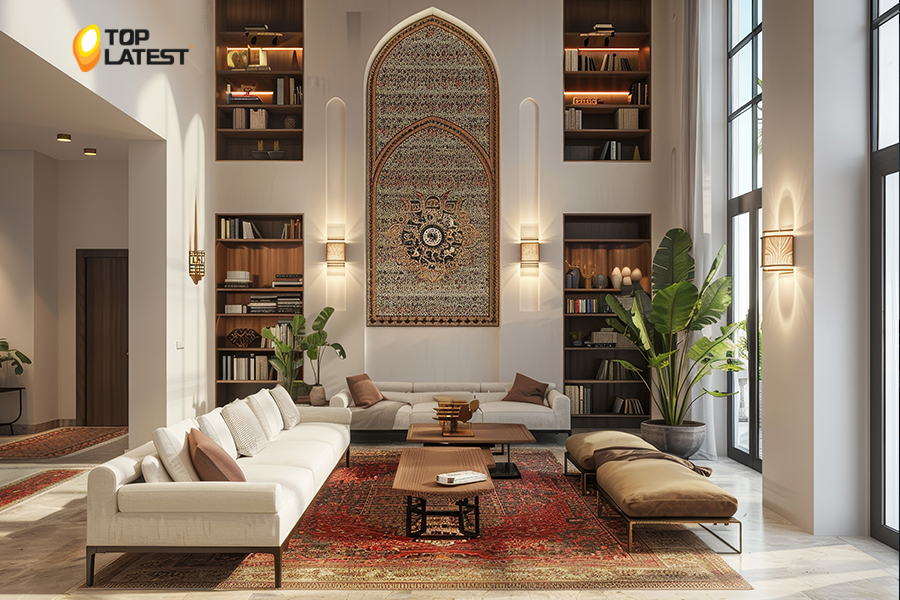
Double height entrances are where a single strong gesture pays off. A tall pierced screen, a stone clad wall, or a suspended cluster of brass pendants gives the volume purpose. Keep floor level furniture minimal so the height reads clearly.
Arabic Modern Ideas for UAE Apartments
Apartments need the same design language delivered through reversible, lighter interventions.
Changes That Suit a Rented Home
Most UAE tenancy agreements restrict permanent alteration, so the workable moves are the removable ones. Freestanding mashrabiya screens, peel and stick zellige style tile for splashbacks, adhesive microcement panels, and plug in wall sconces all deliver the look and come off cleanly at handover.
Ceiling mounted curtain tracks fitted high and wide make standard apartment windows feel architectural, and they are a simple drill and patch job at move out. If you plan any electrical change, keep it within what your building management permits and use a licensed contractor, since fit out approvals are handled at building level across most UAE towers.
Making a Compact Layout Feel Deliberate
In studios and one bedroom units the priority is fewer, larger gestures. One patterned surface, one strong light fixture, one screen. Three well chosen elements read as design. Nine small ones read as clutter.
Mirrors with arched or ogee profiles are particularly effective because the silhouette alone carries the reference while the reflection expands the room. Low furniture also helps, since raising apparent ceiling height is the fastest way to make a compact UAE flat feel generous. These principles sit alongside broader small apartment decor ideas for studios and one bedroom flats.
Materials and Finishes That Perform in UAE Conditions
Design choices that ignore the local climate age badly.
Coastal humidity in Dubai Marina, Corniche, and Al Reem Island causes solid wood to swell and untreated brass to tarnish quickly. Engineered veneer and lacquered or powder coated finishes hold shape and colour far better. For metal, brushed brass and antique bronze wear more gracefully than mirror polish, which shows every fingerprint and water spot.
Sunlight is the other factor. West facing rooms in UAE homes receive intense afternoon exposure that fades textiles and dries out timber. Solution dyed fabrics, UV filtering window film, and layered sheers protect the interior while keeping the light quality the style depends on. This is also where design and running costs meet. Dubai Municipality’s Al Sa’fat green building system sets thermal performance and glazing standards for new buildings in the emirate, and DEWA’s household efficiency guidance points to cooling as the dominant driver of residential electricity use, with window shading among the simplest ways to reduce it. Heavy layered curtains, a defining feature of Gulf interiors, were always doing thermal work as well as decorative work.
Dust is constant. Honed stone, matte paint, and tightly woven textiles stay presentable between cleans far longer than high gloss and open weave alternatives.
Budgeting and Sourcing Across the Emirates
Costs vary widely, and a phased approach is more realistic than a single renovation push.
Custom joinery from Al Quoz and Sharjah industrial workshops is where the character comes from, and it usually needs four to eight weeks lead time. Upholstery and curtain makers in Satwa and Sharjah handle low seating, majlis benches, and floor length drapery at a fraction of retail pricing when you supply your own fabric. Dragon Mart carries screening panels, lighting, and tile at entry level pricing, while imported zellige and hand knotted rugs sit at the premium end.
A sensible sequence is paint and wall finish first, then lighting, then screens and joinery, then textiles and accessories. Each stage stands on its own, so the home never looks half finished. For a wider view of retailers and workshops, our guide on where to buy affordable furniture in the UAE breaks down the main options by budget.
What to Keep in Mind Before You Begin
A few practical points shape how smoothly the process runs. Building management approval is required for fit out work in most UAE apartment towers, and villa communities often have their own external alteration rules. Custom pieces need accurate site measurements taken after any wall finish is applied, not before. Lead times stretch during peak seasons, particularly ahead of Ramadan when demand for majlis work rises sharply. Delivery access for oversized items is worth confirming early, since lift dimensions decide what can reach an upper floor apartment intact.
Bringing the Look Together
Arabic modern interior design works in UAE homes because it was never purely decorative. Filtered light, warm materials, layered textiles, and generous seating all answer real conditions: heat, brightness, dust, and a culture built around hosting. Applied with restraint, the style gives a villa or apartment a sense of place that imported catalogue interiors cannot replicate.
Start with the palette, get the lighting right, and add pattern only where it earns attention. Explore more home decor and property guides on toplatest.ae to see how these ideas play out across different UAE communities and layouts.
Frequently Asked Questions
Arabic modern interior design blends traditional Gulf and Islamic design elements with contemporary restraint. It uses repeating geometry, light filtered through carved or perforated screens, warm neutral palettes, textured plaster, natural stone, and layered textiles. Unlike traditional interiors that layered ornament heavily, the modern version limits strong pattern to one or two surfaces per room. The result reads as calm and architectural while still carrying clear cultural character suited to UAE villas and apartments.
Reversible changes work best, because most UAE tenancy agreements restrict permanent alteration. Freestanding mashrabiya screens, peel and stick zellige style tile, adhesive microcement panels, plug in wall sconces, arched mirrors, and floor length curtains on ceiling mounted tracks all deliver the look without structural work. Low profile furniture raises apparent ceiling height in compact layouts. Any electrical change should stay within building management rules and be handled by a licensed contractor.
Warm neutrals form the base: sand, bone, oat, camel, and clay. These tones handle intense natural light without glare and conceal the fine dust that settles between deep cleans, which cool greys tend to highlight. Add one deep accent such as ink blue, olive, terracotta, or oxblood. Matte and eggshell wall finishes work better than gloss, since satin sheens amplify reflections in rooms with the large glazing common across UAE homes.
A mashrabiya is a carved wooden lattice screen used historically across the Gulf to filter light, assist airflow, and provide privacy. Modern UAE homes use laser cut MDF, powder coated aluminium, or solid walnut versions as room dividers, mezzanine edges, wardrobe fronts, and balcony privacy layers. Keeping the open area above roughly forty percent lets the screen filter light rather than block it, and repeating one motif throughout the home keeps everything coherent.
Coastal humidity and constant dust favour engineered veneer over solid wood, and lacquered or powder coated metal over untreated brass. Brushed brass and antique bronze age more gracefully than mirror polish, which shows every mark. Honed stone, matte paint, and tightly woven textiles stay presentable far longer than gloss and open weave alternatives. For sun exposed rooms, solution dyed fabrics, UV filtering film, and layered sheers protect interiors while preserving light quality.