
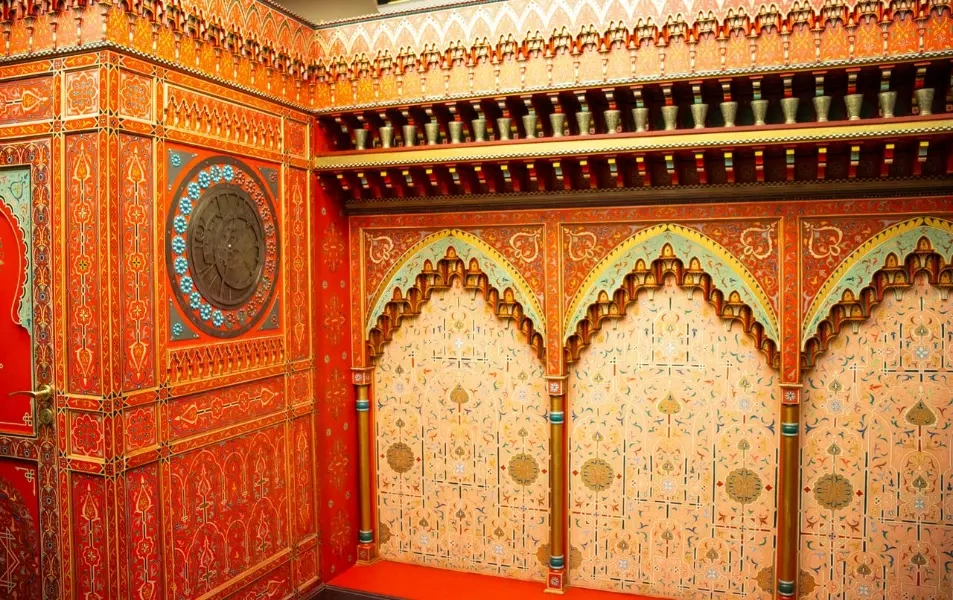
Islamic-inspired interiors carry one of the richest visual languages in design history. Arabesque vines, eight-point stars, mashrabiya screens, and zellige tiles have shaped homes across the region for more than a thousand years. In UAE homes today, the opportunity is to bring these traditions into contemporary architecture with clarity and restraint, so the result feels current, personal, and rooted in place.
This guide shows how to style Islamic art and pattern in a modern UAE home, whether that home sits in Dubai, Abu Dhabi, Sharjah, or one of the northern emirates. The focus is on choices that let the pattern speak without overwhelming the space around it.
Understanding the Visual Vocabulary
Three traditions sit under the umbrella of Islamic-inspired decor, and treating them as one is where most contemporary interiors lose their footing.
Arabesque refers to flowing botanical patterns. Vines, leaves, palmettes, and floral scrolls repeat in symmetrical compositions and feel organic and continuous.
Geometric patterns, often called girih in Islamic art scholarship, are built from polygons, stars, and tessellating shapes. According to the Metropolitan Museum of Art’s department of Islamic Art, these grids originated as expressions of mathematical order rather than pure ornament, which is one reason they translate so well to contemporary architecture built on clean lines and proportion.
Calligraphy uses Arabic script, often Quranic verses or poetic phrases, as visual composition. It carries spiritual weight and asks for a different treatment than purely decorative pattern.
These three categories rarely belong in the same room at full volume. Choose one as your lead, and let the others appear in smaller, supporting roles. For a real-world reference on how traditional motifs sit alongside modern restraint, the architecture of Souk Al Bahar in Downtown Dubai is a useful walk-through.
What Shapes a Contemporary Islamic-Inspired Interior
A few styling habits consistently pull these interiors into a more current register.
The first is editing pattern down to one lead surface at a time. Patterned curtains, patterned carpets, patterned wallpaper, and patterned upholstery in the same space cancel each other out. The eye needs somewhere to rest, and negative space is what lets ornament feel intentional rather than crowded.
The second is treating gold as an accent rather than a baseline. A few gold touches read as luxurious. When gold trims appear on every cushion, frame, lamp, and side table, the room shifts into a hospitality-lobby register that has little to do with contemporary residential design.
The third is respecting scale. Islamic geometric art historically operates at architectural scale: domes, courtyards, and screens. When the same motif is shrunk to coffee-table size and scattered across a room, it loses the presence it was designed to have. Working with one oversized statement piece almost always outperforms ten miniature ones.
Using Arabesque Patterns with Restraint
Arabesque belongs on one surface at a time. Use it on a single feature wall, a hand-painted ceiling medallion, a fabric headboard, or a pair of cushion covers. Let everything around it stay quiet.
Choose tone-on-tone rather than high-contrast colour pairings. Cream on bone, taupe on sand, or soft sage on linen makes the arabesque read as texture rather than decoration. This approach lines up with how heritage motifs are handled in the modern villa interiors covered in our District One Mansions guide, where pattern appears in carefully chosen accent zones rather than across the full interior.
Working with Geometric Patterns: Girih, Mashrabiya, and Zellige
Geometric pattern is the easiest Islamic tradition to modernise, because mathematical order pairs naturally with contemporary architecture.
Mashrabiya screens, the carved wooden lattices traditionally used to filter light and air, now appear in laser-cut metal, MDF, and concrete versions. Use them as room dividers, as headboards, as feature panels behind a sofa, or as sliding doors between living and dining zones. A single screen in matte black or burnished brass anchors a room without dominating it.
Zellige tiles, the hand-cut glazed mosaics rooted in North African craftsmanship, look best in moderate doses. A kitchen backsplash, a powder room wall, or a single fireplace surround in muted greens, whites, or terracottas brings craftsmanship into a contemporary space. Wrapping entire bathrooms in heavily patterned zellige tends to overwhelm the room rather than showcase the tile.
For girih patterns, scale up. A single oversized eight-point star carved into a wooden ceiling panel, etched into a glass partition, or printed onto a wool rug carries more impact than ten small motifs scattered around a room. In villas with double-height entryways, a full-height mashrabiya panel behind the staircase becomes both a light filter and a sculptural statement, and it removes the need for additional wall art in that zone. In apartments, the same effect can be achieved at smaller scale with a single framed girih composition placed at eye level in a hallway.
Lighting choices also change how these patterns read at night. Warm 2700 to 3000 kelvin fixtures behind a mashrabiya screen throw ornate shadow patterns across adjacent walls, which extends the presence of the piece well beyond its physical footprint. Cool white lighting tends to flatten the same effect, which is why the choice of bulb temperature matters as much as the choice of screen itself.
Calligraphy as Decor: Restraint Wins
Arabic calligraphy carries cultural and spiritual significance that purely decorative pattern does not, and it responds well to careful placement.
One framed calligraphy piece, well-lit and given negative space around it, reads as art. A wall of small calligraphy plaques next to gold-trimmed mirrors reads as souvenir clutter. Choose contemporary calligraphers and modern scripts, including work by regional artists shown at the Sharjah Art Foundation and other UAE cultural institutions.
Place calligraphy where it can be paused over: above a console table in an entryway, on a single wall in a study, or behind a reading chair. Many UAE families prefer to keep Quranic calligraphy out of bedrooms and bathrooms, in line with traditional Islamic etiquette, so it is worth thinking about placement before committing to a piece.
Materials and Colours That Bring the Look Forward
The fastest way to refresh Islamic-inspired decor is to swap the surrounding materials, not the patterns themselves.
Pair traditional motifs with raw natural materials: limewashed walls, travertine floors, oak veneer, linen, and unpolished brass. These finishes soften the visual weight that older Gulf interiors tend to carry. The Aga Khan Trust for Culture has documented how restored Islamic-era buildings consistently use limestone, lime plaster, and untreated wood as backdrops to ornate detail, and the same logic translates directly to modern UAE homes.
On colour, lean into a palette drawn from the desert and the region’s traditional architecture: bone, sand, terracotta, deep forest green, dusty rose, and ink blue. Reserve gold for a single accent metal rather than a baseline finish. Matte black, antique brass, and bronze age more gracefully than polished gold across a full interior.
Textiles carry a lot of the work in this look, and choosing them well simplifies every other decision in the room. Heavy velvet and dense damask, once staples of traditional Gulf interiors, can weigh a space down. Linen, raw silk, cotton bouclé, and lightweight wool sit better alongside patterned surfaces because they let the ornament remain the visual event. Layer texture rather than pattern: a bouclé sofa, a linen throw, and a wool rug with a single girih motif form a richer composition than three patterned fabrics competing for attention.
Villa communities that pair Arabic architectural language with modern interiors, such as those covered in our Meadows community overview, offer a useful residential reference for how the look translates at scale, particularly in family homes where different rooms need to serve very different purposes.
Considerations for a Balanced Look
A few practical points help keep the look intentional.
Ceiling height shapes lighting choices. A traditional Moroccan-style brass pendant that looks striking in a courtyard can overwhelm a 2.7 metre apartment ceiling. Scale the fixture to the room rather than the aesthetic.
Pattern-on-pattern works when tones are carefully matched. Two patterns can share a room if one is large and one is small, and both sit within the same colour family.
Authentic handcraft holds its character over time. A few handmade zellige panels or a genuine carved mashrabiya screen retain their texture and depth for years. Machine-stamped copies tend to look flat after the first year. Curated UAE retailers and heritage workshops offer access to authentic pieces without needing to source them from abroad.
Finally, variation across rooms tends to feel more contemporary than full immersion in one aesthetic. A single majlis can carry deeper traditional styling while other rooms use Islamic motifs as quiet accents, and the house as a whole reads as considered rather than themed.
Bringing It Together in a UAE Home
Contemporary Islamic-inspired design in the UAE works best when it treats pattern as an anchor rather than a backdrop. One strong arabesque wall, one carved mashrabiya screen, or one calligraphy piece can define a room more effectively than a full inventory of ornament. For readers exploring related community and interior references, more design and lifestyle guides are available on toplatest.ae.
Sources
- The Metropolitan Museum of Art, Department of Islamic Art
- Aga Khan Trust for Culture
- Victoria and Albert Museum, Middle East Collection
- UNESCO Cultural Heritage documentation
- Sharjah Museum of Islamic Civilization
Frequently Asked Questions
Arabesque patterns are built from flowing botanical forms such as vines, leaves, and palmettes that repeat in symmetrical compositions. Geometric patterns, often called girih in Islamic art scholarship, are constructed from polygons, stars, and tessellating shapes rooted in mathematical order. Arabesque reads as organic and decorative, while geometric reads as architectural and structured. Modern styling in UAE homes usually works best when one is chosen as the lead motif and the other appears as a supporting accent.
Treat mashrabiya as a single architectural feature rather than a recurring decoration. Use one screen as a room divider between living and dining zones, as a sliding panel in front of a wardrobe, as a sculptural headboard, or as a feature panel behind a console. Laser-cut metal or MDF versions in matte black, charcoal, or antique brass suit contemporary interiors well. Keep the surrounding walls and furniture quiet so the screen reads as the focal point.
Yes, when used in the right zones. Hand-cut zellige tiles work beautifully on kitchen backsplashes, powder room walls, fireplace surrounds, and small accent areas. They handle UAE heat and moderate humidity well, though the glazed surface can chip under heavy impact, so floors in high-traffic areas are best avoided. Porcelain and ceramic replicas are more durable but lose the irregular handmade quality that gives authentic zellige its character in a considered residential setting today.
Authentic pieces are available through artisan markets such as Souk Madinat Jumeirah, Souk Al Bahar, and the seasonal heritage pavilions at Global Village in Dubai. Curated retailers including The Odd Piece, Tribe by 3, and Aati stock hand-finished mashrabiya screens, zellige panels, and calligraphy art. For one-off antique and vintage pieces, Dubizzle listings and Dubai Flea Market are worth scanning. Sharjah Heritage Area also houses workshops producing traditional brassware, ceramics, and woven textiles for the home.
Give it space. One well-framed calligraphy piece on a single wall with generous negative space around it reads as art, while multiple small plaques crowded together read as decoration. Light it intentionally with a picture light or a directional spotlight. Many UAE families prefer to keep Quranic calligraphy out of bedrooms and bathrooms, in line with traditional Islamic etiquette. Modern calligraphers working in muted ink tones suit contemporary interiors far better than heavily gilded traditional pieces do.