Strength training has moved firmly into the mainstream of women’s fitness across the UAE. Licensed women only gyms operate throughout Dubai, Abu Dhabi, Sharjah, and the Northern Emirates, certified female coaches are more accessible than ever, and a growing community of UAE based women is building strength as a long term health habit rather than a short seasonal push. The infrastructure, coaching, and cultural comfort now support this decision more clearly than at any point in the past decade.
This guide is written for that reader. It covers how to begin strength training in a way that suits UAE lifestyles, works around the climate, and produces the outcomes resistance training is known for: stronger bones, healthier body composition, improved metabolic markers, and a steady lift in day to day confidence.
The reader in mind is either new to lifting or has tried it briefly and paused. The aim is not to shape a competitive athlete. It is to set up the next two decades of a stronger, more capable body, using a routine that fits UAE workweeks, family rhythms, and seasonal patterns. Everything that follows is built around that practical horizon.
Why strength training matters for women in the UAE
Physical activity remains a public health priority across the UAE. Data reported through the Federal Competitiveness and Statistics Centre and the Ministry of Health and Prevention indicates that adult women in the country tend to report lower activity levels than men, and that lifestyle linked conditions such as type 2 diabetes and reduced bone density are meaningfully present in the adult population. Strength training is one of the most efficient interventions available. It rebuilds muscle, slows age related bone loss, and supports joint health well into later decades.
According to resistance training guidance from the American College of Sports Medicine, adults benefit from working all major muscle groups at least twice weekly, alongside regular aerobic activity. Sustained over years, that dose supports cardiovascular health, insulin sensitivity, and mobility through midlife and beyond.
The UAE fitness landscape today
Women in the UAE now train in single sex facilities with female instructors, in private boutique studios, in residential community gyms with dedicated ladies hours, and increasingly at home with delivered equipment. The National Sports Strategy 2031, coordinated by the Ministry of Sports and Youth alongside the Dubai Sports Council and Abu Dhabi Sports Council, has expanded access, coaching pathways, and community programmes for women’s fitness. Initiatives such as the Dubai Fitness Challenge have moved resistance training from a niche activity into a familiar part of daily life.
The result is a market with real choice. The question is no longer whether a suitable facility exists. It is which model best suits your schedule, comfort level, and goals.
Choosing the training environment that fits you
The most common options for women in the UAE, ordered by how widely they are chosen, are women only commercial gyms, boutique strength studios, residential community gyms, and home setups.
Women only commercial gyms
Chains and independent operators run female only facilities with full free weight sections, machines, and group classes. These are the highest volume choice for beginners because they combine equipment variety with accessible memberships. Central Dubai and Abu Dhabi locations sit at the higher end of pricing, with Sharjah, Ajman, and the Northern Emirates offering more affordable options.
Boutique strength studios
Smaller spaces focused on coaching quality. Cost per session is higher, and the technical instruction is a strong fit for beginners learning compound lifts under close supervision.
Residential community gyms
Many gated communities and apartment buildings across Dubai, Abu Dhabi, and Sharjah include dedicated ladies hours or fully female staffed sessions. Check the equipment inventory before assuming it supports progressive strength work. Many community gyms are still cardio heavy, with limited free weight ranges.
Home setups
Adjustable dumbbells, a sturdy bench, a barbell, and a rack will cover almost all programming needs for years. The consideration is space and upfront investment, not complexity. For readers evaluating amenity rich communities, our overview of life in Green Community West shows how on site fitness facilities factor into the wider lifestyle calculation.
A practical framework for the first twelve weeks
Most beginners overcomplicate week one. A useful starting structure looks like this:
- Two to three sessions per week, avoiding back to back days during the first month.
- Six foundational movement patterns: squat, hinge or deadlift variation, push or press, pull or row, carry, and core brace.
- Three sets of five to eight repetitions per exercise, leaving two to three repetitions in reserve.
- Progress load only when the top of the rep range feels controlled across all sets.
This is not a unique formula. It is the framework most evidence based coaches converge on, including those certified through the National Strength and Conditioning Association. What matters more than the exact program is consistency across twelve weeks. Strength adaptations begin neurologically in the first month and structurally from week six onward.
A helpful reframe for UAE readers is to place resistance work at the centre of the weekly plan rather than as a supplement to long cardio sessions or extended walks. Two strength sessions plus daily walking will deliver more body composition and health benefit than five cardio sessions with no resistance work.
Modest activewear and gym etiquette
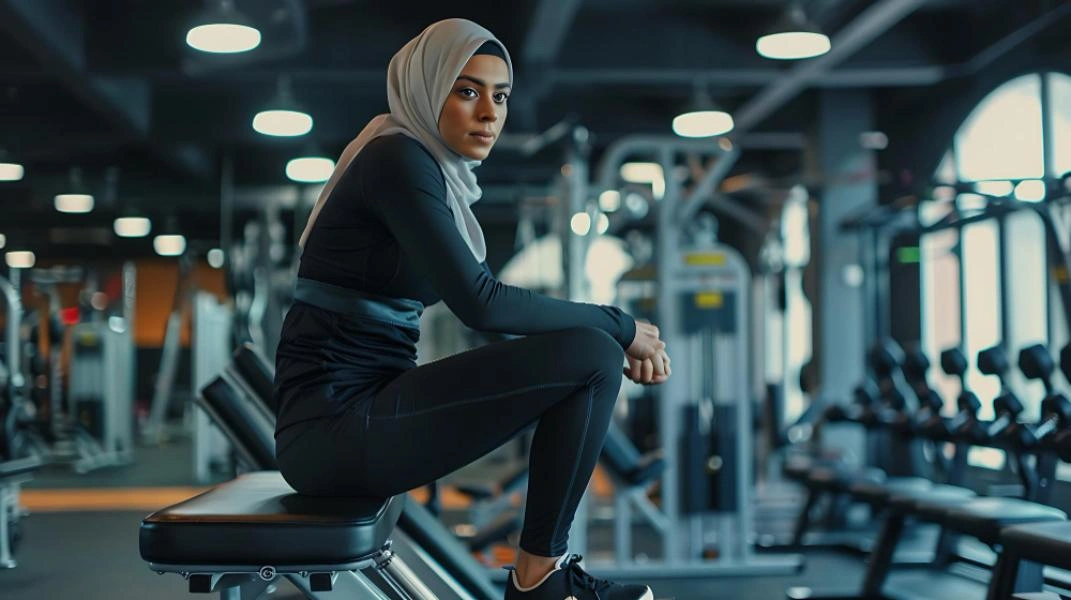
Modest activewear has expanded significantly across the UAE. Regional and international brands now produce performance leggings with longer cuts, breathable long sleeve tops, and sports hijabs designed for heat dissipation. The features that matter for strength training are stretch in the hip and shoulder, sweat wicking fabric, and a fit snug enough that a coach can see your joint positions during lifts.
Inside women only facilities, dress codes are flexible. In mixed settings, fuller cover is expected and easily accommodated with the modest activewear ranges now widely available. Bring an indoor pair of trainers, a personal mat or towel for shared surfaces, and a refillable bottle. Phone use during sets, particularly photography, is restricted by policy in most UAE female gyms.
Nutrition, hydration, and training in the UAE climate
The UAE is hot for much of the year. Even indoor training during summer months places a higher demand on hydration than equivalent training in temperate climates. A useful daily baseline is roughly thirty five millilitres of water per kilogram of body weight, with additional intake on training days. Electrolyte replacement matters more here than the generic global advice suggests, particularly for anyone who trains after outdoor errands or a school run.
Protein intake is the variable most beginners underestimate. Current evidence supports 1.6 to 2.2 grams of protein per kilogram of body weight per day for women building strength, distributed across three to four meals. UAE diets rich in lamb, chicken, fish, dairy, and pulses make this achievable without supplementation, though a quality whey or plant protein can simplify post training intake.
During Ramadan, scale back training volume rather than intensity. Two shorter sessions per week after iftar, focused on the main lifts, will preserve muscle and strength while respecting fasting recovery.
What the evidence actually shows
A few points come up regularly in first coaching conversations, and the current evidence is clear on each.
Strength work builds shape, not bulk. Female physiology, including the lower androgen profile, makes significant muscle gain a slow and deliberate process even for those actively pursuing it. Most women describe the visible result as leaner and more defined, not larger.
Resistance training supports fat loss well. For a fixed weekly time budget, resistance training combined with adequate protein produces stronger body composition outcomes than the same time spent on cardio alone. Cardio remains valuable for cardiovascular health and pairs naturally with strength work.
Strength training is compatible with pregnancy and postpartum recovery. Cleared by a physician, resistance training is recommended through pregnancy and postpartum by major obstetric bodies. Programming adjusts across trimesters and the fourth trimester, and the activity itself continues.
Practical considerations for the first year
- Time. Strength training rewards consistency over intensity. Two focused hours per week, sustained, delivers more than six hours across a month followed by a long pause.
- Cost. Women only gym memberships across UAE cities span a wide range, and home equipment carries a higher upfront cost with lower long run spend. Both models work.
- Privacy. Some readers prefer fully private studios even within women only facilities. The premium is real, and so is the adherence benefit if it removes friction around attending.
- Coaching quality. A certified female coach in the first three months is the single highest leverage investment. Early form habits are easier to build correctly than to unlearn later.
Communities with strong on site fitness facilities have become a meaningful differentiator across the UAE. Our feature on luxury living in Emirates Hills illustrates how integrated amenities shape daily fitness routines in mature residential districts.
Building something that lasts
Strength training works because it compounds. Skill, load, and confidence all improve together. The UAE context supports this far better than most newcomers assume. The gyms exist, certified coaches are accessible, equipment is widely available, and community support for women’s fitness has settled into daily life.
The reader who begins this week, learns to brace a heavy squat by month three, and is loading meaningful weight on a hinge by month six will look back at the starting point with quiet satisfaction. The starting decision is small. The downstream effect on bone density, metabolic health, and how you carry yourself through your forties and fifties is not. For readers weighing how residential choices intersect with daily wellness, our guide to top family communities in Dubai offers a useful lens on how amenity planning shapes fitness habits across the Emirates.
Sources
- Dubai Sports Council, women’s fitness participation and licensed facility standards
- UAE Ministry of Sports and Youth, National Sports Strategy 2031
- American College of Sports Medicine, resistance training guidelines for adults
- National Strength and Conditioning Association, beginner programming standards
- UAE Federal Competitiveness and Statistics Centre, national physical activity and health indicators
Frequently asked questions
Yes. Women only fitness facilities are established across Dubai, Abu Dhabi, Sharjah, Ajman, Ras Al Khaimah, Umm Al Quwain, and Fujairah, and operate under standards coordinated through the Dubai Sports Council, Abu Dhabi Sports Council, and the wider Ministry of Sports and Youth framework. Options range from large chain gyms to boutique studios and private personal training spaces. Facilities must meet equipment, safety, and staffing standards, and many operate with female trainers, managers, and reception teams throughout opening hours.
Two to three non consecutive days per week is the right starting dose for almost all beginners. This allows full nervous system and muscle recovery between sessions, which is when strength adaptations actually occur. After six to eight weeks of steady training, moving to three or four sessions split across upper and lower body days is a natural next step. More frequent training without careful programming tends to produce fatigue and injury risk rather than faster progress.
Comfortable, fitted athletic clothing that lets a coach see your joint positions during lifts. Leggings or athletic trousers, a moisture wicking top, and proper indoor training shoes are the standard kit. Many women in the UAE prefer long sleeve performance tops and longer legging cuts even inside female only spaces, which works well for strength training. Inside private studios, you can dress as comfortably as at home. Always bring a personal mat and a refillable water bottle.
Yes, with adjustments. Most experienced coaches recommend reducing weekly volume by roughly thirty to forty percent and shifting sessions to one to two hours after iftar, once you have rehydrated and eaten. Focus on the main compound lifts rather than long accessory work, and keep sessions to about forty five minutes. Maintain protein intake across suhoor and iftar at your normal daily target. Most women maintain strength through Ramadan with this approach, and some continue to make modest progress.
For the first eight to twelve weeks, a certified female trainer is the single most valuable investment for a UAE based beginner. Online videos teach movement patterns well, but they cannot correct your specific form, breathing, or load progression in real time. After three months, when foundational patterns are well established, supplementing with high quality online programming and occasional check in sessions becomes reasonable. The cost of early coaching is small relative to the cost of unlearning inefficient habits later.