Most things humans build vanish into background noise from orbit. Cities blur into grey. Highways thin into threads. Even mountains lose definition. Yet a handful of structures are so large, so geometrically distinct, or so contrasted against their surroundings that astronauts can pick them out from 400 kilometres above Earth.
Three of those four sit in the United Arab Emirates. That alone says something about the scale at which this region builds. Here is what is actually visible, why it matters, and what it quietly tells you about Dubai’s place in the global property conversation.
First, A Quick Reality Check On “Visible From Space”
Space starts at the Kármán line, 100 kilometres above sea level. The International Space Station orbits at roughly 400 kilometres. From that altitude, NASA confirms only certain structures are identifiable, and many of those require a telephoto lens. The Great Wall of China, contrary to popular belief, is generally not visible to the naked eye because it follows terrain and blends into it.
What stands out from orbit shares three traits: large surface area, sharp contrast with surroundings, and geometric shapes nature does not produce. The four structures below meet all three.
1. Palm Jumeirah, Dubai
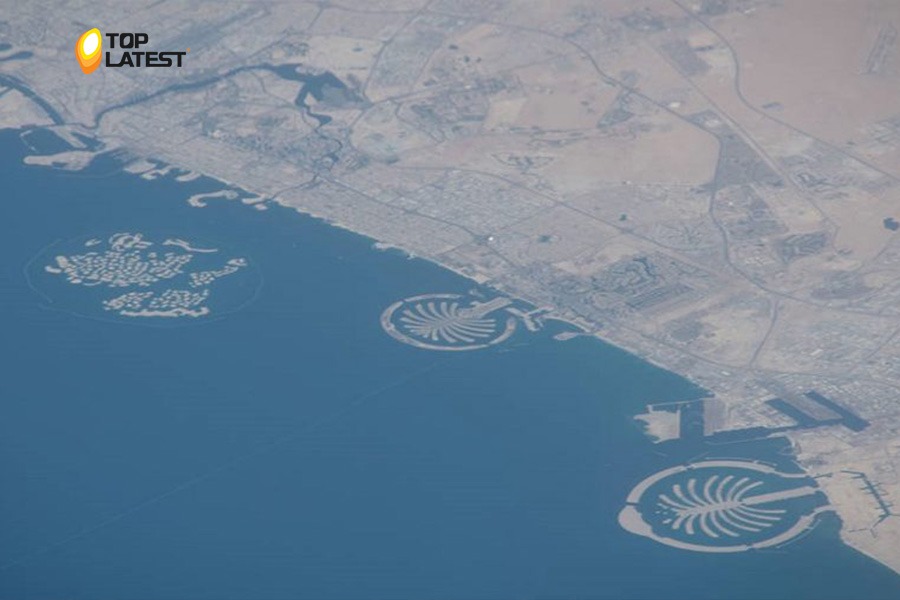
Palm Jumeirah is the most photographed man-made structure in NASA’s astronaut imagery archive, and for good reason. According to NASA’s Earth Observatory, construction began in 2001 and required more than 50 million cubic metres of dredged sand to raise the islands above the Persian Gulf.
From orbit, the palm shape is unmistakable. Sixteen fronds extend from a central trunk, encircled by a crescent breakwater. No natural coastline produces that geometry. Astronauts identify it within seconds.
What the orbital view does not show is the real estate density now packed onto it. The trunk hosts mid rise apartments. The fronds carry signature villas. The crescent holds resort branded residences from Atlantis, Waldorf Astoria, and the W. Yields here have stayed firm even as broader markets corrected, driven by a buyer pool that values scarcity over square footage.
For anyone running through a dubai property buyers guide checklist, Palm Jumeirah is a useful reference point: when global capital comes to Dubai, this is one of the addresses it tends to land at first.
2. The World Islands, Dubai
A few kilometres off the coast, three hundred small islands arranged into a rough map of the continents are also visible from the ISS. NASA documented their construction beginning in 2003, completed in 2008, using 320 million cubic metres of sand and 37 million tonnes of rock for a 27 kilometre protective breakwater.
The World is harder to read from orbit than Palm Jumeirah. The individual islands are small, and without infrastructure to add contrast, the outline of the continents takes a sharp eye to spot. Yet under good light, the cluster reveals itself as something planned, not natural.
Development on The World has moved in waves. The Heart of Europe project, with its Floating Seahorse villas and weather controlled “rainy streets” on Germany Island, has shifted parts of the archipelago from concept to delivery. It remains one of the most unusual property propositions in the region, and one of the few residential plays globally that sits inside a NASA visible postcode.
For lifestyle context on how Dubai handles ultra premium island and waterfront living, the feature on The Hartland Villas on TopLatest covers a comparable tier of mainland luxury.
3. Burj Khalifa, Dubai
A building, technically, is harder to see from space than an island. Buildings are vertical. Orbital photography looks straight down. Most skyscrapers reduce to a small grey square.
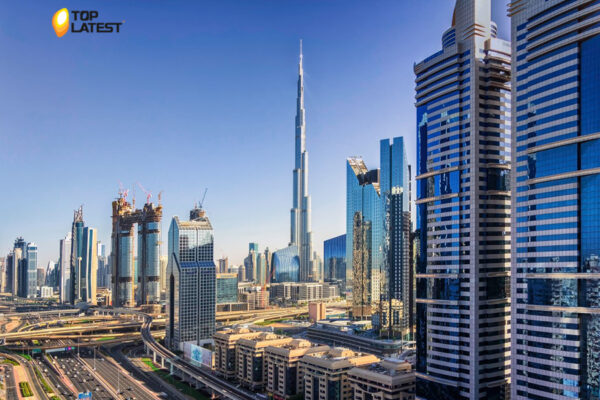
Burj Khalifa is the exception. At over 828 metres, it is roughly three times the height of the Eiffel Tower, and its needle profile casts a long, dark shadow across central Dubai. NASA’s astronaut imagery has captured both the tower’s tapered footprint and that distinctive shadow, which is what actually makes the structure identifiable from orbit. The building itself reads as a dot. The shadow reads as a marker.
That detail matters for residents and investors. Burj Khalifa anchors Downtown Dubai, one of the highest yielding residential zones in the city. The tower’s lower floors hold Armani Residences. Surrounding it sit The Address, Burj Vista, Opera Grand, and Boulevard Heights. Rental demand here is driven by proximity to DIFC, the Dubai Mall, and the metro, with consistently high occupancy across studio to four bedroom inventory.
For buyers shortlisting Downtown against alternatives like Dubai Marina or Business Bay, a structured dubai property buying checklist helps weigh service charges, view premiums, and exit liquidity against headline rental yield. Downtown rarely loses that comparison on liquidity.
4. The Great Pyramids of Giza, Egypt
The fourth structure sits outside the UAE but inside the wider MENA region, and it has been visible from space far longer than anything humans currently build.
The three pyramids at Giza were constructed around 2500 BC. The Great Pyramid of Khufu rises 139 metres. Their sandstone surfaces contrast strongly with the surrounding desert, and their precise geometry, three near perfect triangles in formation, is what allows astronauts to pick them out.
Visibility to the naked eye is contested. British astronaut Tim Peake has said he could not see them unaided. Former NASA ISS commander Leroy Chiao insists he could. Both agree that with an 800 millimetre lens, the pyramids are unambiguous in astronaut photography.
What the pyramids add to this list is a useful counterweight. Three of the four structures here were built in the last quarter century. The fourth has been visible for forty five centuries. Scale, in human terms, is not a modern invention. The UAE has simply added geometry and contrast at a pace nowhere else in the region matches.
What These Four Structures Quietly Say About Dubai
Three of the four orbit visible man-made landmarks in the MENA region sit within a thirty kilometre radius of Dubai’s coastline. That is not coincidence. It is the result of a development model that prioritises scale, geometry, and visual signature alongside utility.
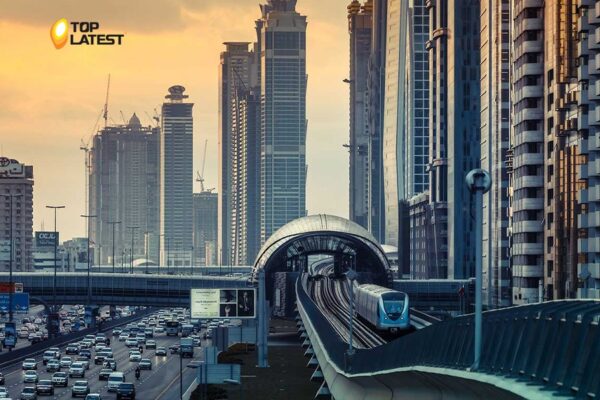
For property buyers, the takeaway is practical. The same scale of ambition that produced visibility from space also produced the infrastructure backbone that supports residential value: metro coverage, port logistics, free zone economic clusters, and a population that crossed four million in 2025.
For a deeper look at how that infrastructure translates into livable neighbourhoods, the guide to Dubai’s top family communities on TopLatest is a useful companion read.
Frequently Asked Questions
Is the Great Wall of China really visible from space?
Mostly no. NASA and multiple astronauts, including Chris Hadfield and Yang Liwei, have confirmed the Great Wall is not visible to the naked eye from the International Space Station. The wall is only five to eight metres wide and follows terrain that camouflages it. Under very specific conditions and with telephoto lenses, small sections have been photographed, but the popular claim that it is the only man-made structure visible from space is a long standing myth, not a fact.
Why is Palm Jumeirah visible from space when other coastal developments are not?
Three reasons. First, scale: Palm Jumeirah covers roughly 560 hectares and required tens of millions of cubic metres of sand to construct. Second, contrast: the white sand and built footprint stand out sharply against the dark blue Persian Gulf. Third, geometry: a stylised palm tree with sixteen fronds and a crescent breakwater is a shape nature does not produce, so the human eye picks it out instantly in any orbital photograph, with or without a telephoto lens.
Can the Burj Khalifa actually be seen from the International Space Station?
Yes, though indirectly. The tower itself reads as a small dot from 400 kilometres up, but its 828 metre height casts a long, dark, needle shaped shadow across Downtown Dubai that astronauts can identify clearly in photography. NASA’s published astronaut imagery has captured this shadow alongside the tower’s tapered footprint. So while you do not really see the building, you absolutely see the proof that something exceptionally tall is standing there.
Are any other UAE landmarks visible from orbit besides Palm Jumeirah and Burj Khalifa?
The World Islands, Nakheel’s 300 island archipelago shaped like a world map, are visible under good light. Palm Jebel Ali, currently being revived after years of pause, will join the list once construction reaches a more advanced stage. The broader urban footprint of Dubai and Abu Dhabi is also clearly identifiable at night because of street lighting density, but those are city scale signatures rather than individual structures. The Sheikh Zayed Grand Mosque is recognisable in high resolution satellite imagery.
Does NASA confirm which structures are visible from space?
NASA has published astronaut photographs and Earth Observatory case studies documenting Palm Jumeirah, the World Islands, the Burj Khalifa shadow, the Pyramids of Giza, the Three Gorges Dam, the Bingham Canyon Mine, and the greenhouse complex at Almería in Spain. The agency distinguishes between naked eye visibility and lens assisted photography, which is why the same structure may be described as visible in one context and not visible in another. Always check the conditions before repeating any claim.
Sources
- NASA Earth Observatory
- Nakheel Properties
- Emaar Properties
- International Space Station (NASA Astronaut Photography)
- Dubai Statistics Center