Ras Al Khaimah has moved from a quiet coastal alternative into one of the UAE’s most watched property markets. The emirate now offers a distinct proposition: waterfront living, freehold ownership open to all nationalities, and pricing that still trades at a meaningful discount to Dubai. For buyers and investors thinking beyond the country’s established hubs, understanding how this market works is the first step toward a confident allocation.
This guide walks through the zones, fundamentals, regulatory framework, and practical considerations that shape property investment in Ras Al Khaimah today.
Why Ras Al Khaimah Is Attracting a New Wave of Investors
Three forces have redefined the emirate’s real estate story. The first is tourism-led infrastructure. Ras Al Khaimah has publicly committed to hosting 3.5 million annual visitors by 2030, and hospitality investment has followed. The second is the arrival of anchor developments such as Wynn Al Marjan Island, a AED 18.7 billion integrated resort scheduled to open in 2027 that has repositioned the emirate on the international map. The third is diversification: manufacturing, logistics, tourism, and real estate together support a broader economic base, with local GDP estimated to have grown by 4.3 per cent in 2025 according to a Cavendish Maxwell market review.
The result is a market with genuine end-user demand, expanding rental depth, and pricing that still sits well below the more established freehold zones in Dubai and Abu Dhabi.
The Investment Zones Shaping the Market
Ras Al Khaimah’s investable stock is concentrated in a handful of designated freehold areas, each with its own character and buyer profile. The following order reflects current demand and transaction depth.
Al Marjan Island
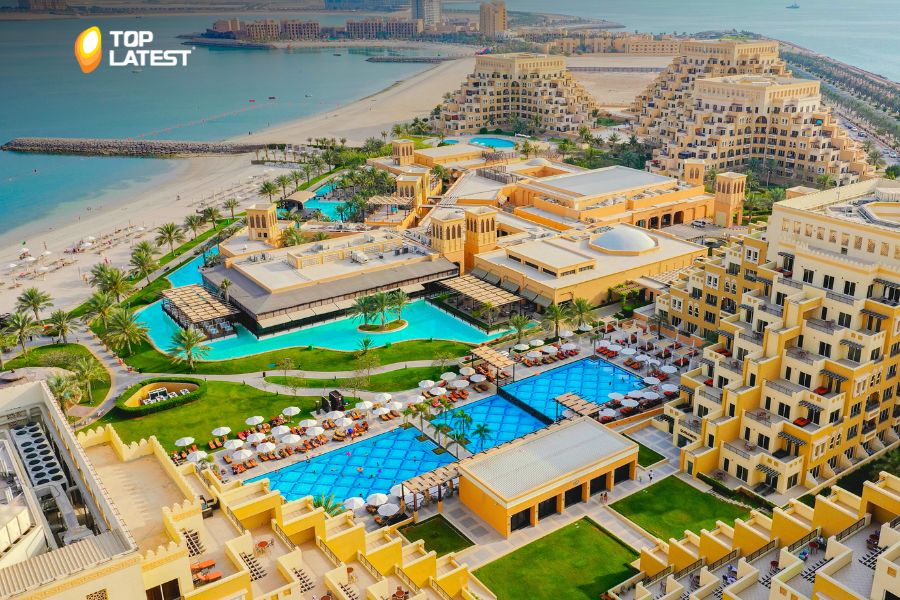
Al Marjan Island is the emirate’s headline destination and currently attracts the largest share of investor attention. As a designated freehold zone open to all nationalities, it hosts a growing pipeline of branded residences, hotel apartments, and beachfront towers. Al Marjan Island apartments recorded roughly 13.2 per cent annual capital growth in the first quarter of 2026, the strongest performance in the emirate. Proximity to Wynn Al Marjan Island, direct beach frontage, and a maturing masterplan explain the sustained appeal for both capital-growth-focused buyers and short-term rental operators.
Al Hamra Village
Al Hamra Village is the emirate’s most established freehold community. Home to a marina, an eighteen-hole championship golf course, retail, hotels, and a wide mix of apartments, townhouses, and villas, Al Hamra offers the kind of settled rental market that appeals to income-focused investors. Al Hamra villas posted around 9.1 per cent annual capital appreciation in early 2026, while its apartments delivered close to 8.1 per cent. The community’s tenant base is deep and stable, which supports occupancy through market cycles.
Mina Al Arab and Hayat Island
Mina Al Arab is a mixed-use waterfront masterplan that has expanded steadily in recent years, with Hayat Island emerging as its most active investment cluster. Mina Al Arab villas grew by roughly 5.9 per cent annually in early 2026. The community appeals to buyers who want lifestyle-oriented waterfront property at prices below Al Marjan’s headline levels, with a growing pipeline of townhouses and mid-rise apartments.
Emerging Freehold Communities
Beyond these three anchors, newer masterplans are entering the market with off-plan launches in areas designated by RAK Municipality. These sit further along the risk-and-reward curve. Entry prices are lower, delivery timelines are longer, and pricing is more sensitive to the broader supply pipeline, which is expected to deliver around 1,300 units in 2026 and 1,900 in 2027 before scaling further.
Reading the Market Fundamentals in 2026
The most useful way to think about Ras Al Khaimah today is as a market in a deliberate consolidation phase rather than a cooling one. Total residential transactions eased in 2025 to around 6,600 sales, with total value at approximately Dhs12.4 billion, reflecting a more selective off-plan launch environment. At the same time, prices continued to move upward: apartment values rose by roughly 13.4 per cent and villa values by 9.7 per cent across the year.
Rental performance has now become the leading signal. Apartment rentals in prime areas climbed by close to 12 per cent year on year in early 2026, while villa rentals recovered strongly after new stock was absorbed. This is the pattern of a maturing market where occupier demand is catching up to capital values, which typically supports more sustainable yields over time.
The average gross rental yield across the emirate’s freehold residential market sat at approximately 5.3 per cent in early 2026, according to a ValuStrat quarterly review. That places Ras Al Khaimah broadly in line with well-priced Dubai stock while offering a lower entry point.
Ownership Rules, Regulation, and the Legal Framework
Ras Al Khaimah operates its own real estate regulator, which sits under Ras Al Khaimah Municipality and oversees developer licensing, broker registration, and escrow arrangements. It is a separate authority from Dubai’s Land Department or RERA, so buyers coming from other emirates should not assume the same processes carry over.
All nationalities can purchase freehold property in designated zones, and titles are registered with RAK Municipality. Buyers typically budget for registration fees, transfer costs, and a service charge that varies by community and building specification. Service charges in beachfront developments generally sit higher than inland stock due to shared amenity load.
For investors, ownership of property valued at AED 2 million or more can qualify the holder for the UAE’s 10-year Golden Visa, a pathway that has increased long-term investor interest across the emirate. Buyers exploring this route can review the detailed criteria in our UAE Golden Visa through property investment guide.
Rental Yields, Capital Growth, and the Return Profile
Property investment in Ras Al Khaimah tends to sit in one of three return profiles. Waterfront apartments in Al Marjan Island lean toward capital growth, supported by the Wynn opening cycle and constrained beachfront supply. Al Hamra properties lean toward steady income and moderate appreciation, benefiting from an established tenant base. Off-plan stock in earlier-stage communities is priced for future delivery, with returns depending heavily on construction progress and area maturity.
Short-term rental operators have also expanded across coastal communities, driven by tourism growth. However, gross short-term yields depend on furnishing, positioning, and management quality. Investors evaluating this route should factor operational costs before comparing headline figures to long-term rental returns. Our off-plan property investment guide for the UAE covers the specific considerations for buying pre-completion.
Practical Considerations for a Confident Purchase
A few points shape a smoother buying experience in the emirate.
Confirm the developer track record. Ras Al Khaimah has a small pool of active master developers alongside a growing list of newer entrants. Delivery history, completed inventory, and quality of finish vary meaningfully. Reviewing prior handovers in the same community is one of the most useful diligence steps a buyer can take.
Understand the payment structure. Off-plan payment plans in Ras Al Khaimah typically follow construction milestones, with post-handover options available on selected launches. Reading the schedule against the projected delivery quarter matters more than the headline discount.
Check the service charge and community fee structure. Beachfront and branded communities carry higher running costs, which affect net yield calculations.
Factor the supply pipeline. With deliveries expected to accelerate meaningfully from 2027 onward, entry pricing today should account for the absorption dynamics that a larger pipeline will bring.
Explore live inventory across the emirate through our Ras Al Khaimah property listings to compare configurations, price points, and community profiles.
Building an Investment Strategy That Fits Your Goals
A workable Ras Al Khaimah strategy usually starts with the investor’s own objective. Capital-growth-focused buyers with a longer horizon tend to concentrate on Al Marjan Island and prime waterfront launches, accepting a lower current yield in exchange for exposure to the tourism cycle. Income-focused buyers weight established communities such as Al Hamra Village, where occupancy is steady and management is straightforward. Lifestyle buyers who intend to occupy the property benefit from evaluating community amenities, school access, and daily commute considerations alongside financial returns. Reviewing a curated selection of active launches on our Al Marjan Island property page can help sharpen shortlists before committing.
Across all three profiles, entering the market with a clear budget for closing costs, service charges, and a maintenance reserve gives a more accurate picture of net return than headline pricing alone.
Bringing It Together
Ras Al Khaimah has moved into a phase where infrastructure, regulation, and international attention are aligning. The market rewards buyers who match the right community to the right objective, understand the fundamentals rather than the headline growth figures, and treat diligence as part of the return calculation. For investors evaluating the emirate today, the opportunity is grounded in real transaction data, real construction progress, and a supply pipeline that will shape the next cycle.
Explore more Ras Al Khaimah market analysis and community guides on toplatest.ae, or connect with a licensed real estate professional to review your options in detail.
Sources
- Cavendish Maxwell, Ras Al Khaimah Residential Market Review
- ValuStrat, Ras Al Khaimah Quarterly Property Market Research Report, Q1 2026
- Wynn Resorts, Wynn Al Marjan Island Project Disclosures
- Ras Al Khaimah Municipality, Real Estate Regulatory Framework
- Ras Al Khaimah Tourism Development Authority, Destination Strategy 2030
Frequently Asked Questions
Ras Al Khaimah has entered a maturing phase where prices, rents, and infrastructure are advancing together. Apartment values rose around 13.4 per cent and villa values 9.7 per cent through 2025, while gross rental yields sit close to 5.3 per cent across freehold zones. Combined with the Wynn Al Marjan Island opening in 2027 and steady tourism-led demand, the emirate now offers a credible, data-supported market for both capital growth and income-focused investors.
Ras Al Khaimah offers freehold ownership to all nationalities within designated zones. The most active are Al Marjan Island, Al Hamra Village, Mina Al Arab, and Hayat Island, each with distinct pricing, community characteristics, and buyer profiles. Title registration is handled through Ras Al Khaimah Municipality, and the emirate’s own real estate regulator oversees developer licensing and escrow arrangements. Newer masterplans continue to expand the pool of freehold options available to international buyers seeking waterfront and lifestyle exposure.
Gross rental yields across Ras Al Khaimah’s freehold residential market averaged approximately 5.3 per cent in early 2026, placing the emirate broadly in line with well-priced Dubai stock at a lower entry point. Yields vary by community and product type, with hotel apartments and short-let-friendly waterfront units typically higher than long-term let villas. Investors should factor service charges, management costs, and vacancy assumptions to build an accurate view of net return before committing.
Wynn Al Marjan Island is a AED 18.7 billion integrated resort scheduled to open in 2027 and has become the emirate’s most significant tourism catalyst. Its arrival has drawn branded residence launches, upgraded infrastructure, and heightened international investor attention, particularly on Al Marjan Island and neighbouring waterfront communities. Part of the growth expected from the opening is already reflected in current pricing, so buyers should evaluate entry values against today’s rental fundamentals rather than projected upside alone.
Yes. Property ownership valued at AED 2 million or more qualifies the holder for the UAE’s 10-year Golden Visa, and this threshold applies across all seven emirates including Ras Al Khaimah. Both completed and off-plan purchases through approved developers can be considered, subject to specific documentation and title requirements. This route has meaningfully increased long-term investor interest in Ras Al Khaimah, particularly among buyers seeking waterfront lifestyle assets combined with residency flexibility.