
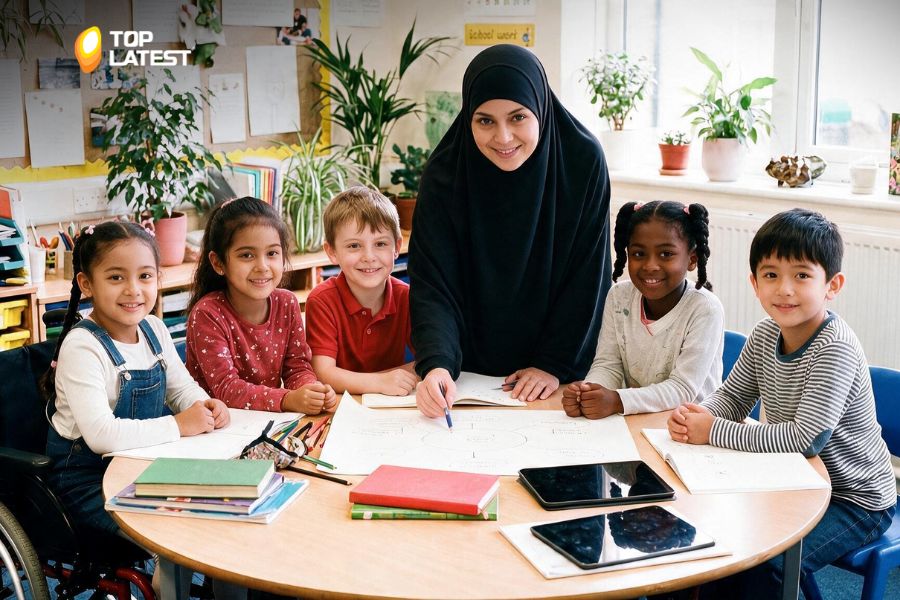
Every child learns differently. Some move through the curriculum at pace, some take a scenic route, and some need a different kind of scaffolding to reach the same milestones. In the UAE, that recognition is no longer a quiet acknowledgement inside individual classrooms. It sits at the centre of a national education agenda that treats inclusion as a marker of school quality, and it treats children with special educational needs as students of determination who belong in the same schools, corridors, and playgrounds as their peers.
For families raising a child with a learning, developmental, sensory, physical, or emotional profile that needs additional support, the UAE has become one of the most structured environments in the region to navigate. Regulators publish frameworks, schools are inspected against inclusion benchmarks, and specialist services are increasingly built into mainstream campuses rather than kept apart from them. This guide walks you through what SEN support looks like across Dubai, Abu Dhabi, Sharjah, and the wider UAE in 2026, and how to make informed choices as a parent shaping your child’s education.
How the UAE Frames Special Educational Needs
The UAE uses the term “students of determination” to describe children who would elsewhere fall under the umbrella of special educational needs or disabilities. The shift in language is deliberate. It reframes support around ability and progress rather than around what a child cannot do, and it aligns schooling with the wider national vision of participation and contribution.
The needs covered under this framework are broad. They include learning differences such as dyslexia, dyscalculia, and dysgraphia, developmental profiles including autism spectrum condition and attention deficit hyperactivity disorder, sensory impairments affecting vision or hearing, physical and motor conditions, speech and language delays, and social, emotional, and mental health needs. Gifted and talented learners are also formally recognised, since their profile calls for a similarly individualised approach.
The Regulatory Foundation Behind Inclusive Schools
The legal backbone comes from UAE Federal Law No. 29 of 2006, later amended by Federal Law No. 14 of 2009, which established the rights of people of determination to equal access, education, and inclusion. On the ground, this translates into a layered regulatory system.
In Dubai, the Knowledge and Human Development Authority sets policy for private schools through the Dubai Inclusive Education Policy Framework, first issued in 2017 and updated in subsequent cycles. Schools are inspected annually against inclusion standards as part of the Dubai Schools Inspection Bureau evaluation, and their provision for students of determination directly influences their overall rating. According to KHDA reporting, tens of thousands of students of determination are enrolled across Dubai private schools, and the number has grown steadily each academic year as identification and reporting have matured.
In Abu Dhabi, the Department of Education and Knowledge oversees inclusion in both public and private schools, with its own inclusion policy and specialist school licensing. Sharjah Private Education Authority, Ras Al Khaimah’s Department of Knowledge and Human Resource Development, and the Ministry of Education for federal public schools all operate under a shared national vision, coordinated with the Ministry of Community Development.
What SEN Support Looks Like in UAE Classrooms Today
Modern SEN provision in UAE schools is built around a graduated response. When a child shows signs that they may benefit from additional support, the school moves through a defined pathway rather than reaching straight for a specialist placement.
The first layer is quality classroom teaching, adapted through differentiated instruction. Teachers modify how they present material, how they check for understanding, and how they allow children to demonstrate what they know. Many UAE schools now apply universal design for learning principles, so adjustments are built into lessons from the start rather than added on afterwards.
The second layer is targeted intervention. A learning support assistant may work with the child inside the classroom or in small groups. Reading recovery programmes, structured literacy interventions such as Orton Gillingham, numeracy catch up programmes, and social skills groups are common examples.
The third layer is individualised specialist support. An Individual Education Plan, sometimes called an Advanced Learning Plan for gifted learners, is drawn up in partnership with parents. Speech and language therapists, occupational therapists, educational psychologists, and behaviour analysts often work on campus or in close partnership with the school. Assistive technology, including reading pens, text to speech software, and communication apps, has become a standard part of the toolkit as educational technology across UAE schools matures.
Choosing a School That Fits Your Child’s Learning Profile
For families new to the UAE or moving between emirates, school choice is often the most consequential decision. Inclusion practice varies from campus to campus even within the same curriculum family, so the goal is to look past marketing language and understand how support actually works day to day.
Start with the most established inclusive schools. Several long standing British, American, IB, and Indian curriculum schools in Dubai and Abu Dhabi have deeply embedded inclusion departments, with dedicated Heads of Inclusion, in house therapy teams, and multi year track records of moving students of determination successfully through primary, secondary, and into further education. These schools tend to appear consistently in KHDA and ADEK ratings for inclusive practice.
Alongside mainstream inclusive schools, the UAE has a small but growing set of specialist schools and centres designed for children whose needs are best met in a fully specialist environment. These operate under specific licences and typically follow modified curricula tailored to the profiles they serve.
When evaluating a school, look for these signals. A clear inclusion policy published on the school’s own site. A named Head of Inclusion or SENCo with a specialist qualification. Transparent information on how Individual Education Plans are written, reviewed, and shared with parents. On campus or partnered therapy services. And a track record of student progress the school can talk about in specifics rather than in general statements.
Parents newer to the country often find it helpful to layer this research on top of a broader guide to leading international schools in Dubai and Abu Dhabi, so that curriculum fit, community fit, and inclusion capability are considered together rather than in isolation.
Starting the Journey Early
For young children, the nursery and kindergarten years are often when learning differences first become visible. Early identification remains one of the strongest predictors of long term progress. Speech delays, motor coordination issues, and social communication differences are far easier to support at ages three, four, and five than later on. UAE nurseries licensed by the Ministry of Education and by emirate level authorities increasingly work with visiting therapists and offer structured transition planning into primary school.
This is why families raising young children benefit from thinking about inclusion from the very first stage of early childhood education, rather than waiting for a formal school setting to raise the question.
The Cost and Funding Landscape for SEN Support
Fees for inclusive provision in UAE private schools sit alongside standard tuition and vary based on the level of support a child needs. Schools generally categorise support into tiers, ranging from light in class adjustments included in standard fees, to intensive one to one shadow teacher support charged as an additional package. Therapy sessions delivered on campus by external providers are usually billed separately.
Government supported schools under the Ministry of Education and public schools in Abu Dhabi provide inclusion services to Emirati students at no additional cost, and private schools receive KHDA and ADEK guidance to ensure fees for students of determination remain proportionate and transparent. Some emirate level funds and community programmes assist eligible families with therapy costs, and health insurance policies in the UAE increasingly cover assessments and therapies when medically prescribed.
Working With Your Child’s School as a Parent
The most consistent finding across inclusive school communities in the UAE is that outcomes improve when parents and schools work as partners. That partnership tends to have three anchors. Regular structured meetings with the inclusion team, ideally each term. Clear documentation of goals, progress, and next steps so that everyone is working from the same plan. And a shared willingness to adjust when something is not working, without waiting for a full academic year to pass.
Expat parents adjusting to a new school system often find that the tone in UAE schools is more collaborative than they expected, and that regulators actively encourage parent voice. For families settling into the country, pairing this with a broader orientation to life in the UAE can make the first year of school significantly smoother for the whole family.
The Road Ahead for Inclusive Education in the UAE
The direction of travel is clear. Inclusion is now a benchmark of school quality, not a specialist niche. Teacher training programmes are embedding inclusive practice as a core competency. Assistive technology is becoming standard. Data on student progress is being reported more transparently. And children who might once have been quietly directed away from mainstream schooling are being enrolled, taught, and celebrated inside it.
For families raising a child with additional learning needs in the UAE in 2026, the environment is more supportive, more structured, and more informed than at any point in the country’s education history. With the right school, the right plan, and the right partnership, your child’s learning profile becomes a starting point for a considered educational journey, not a barrier to it.
To go deeper into curriculum options, community fit, and school selection across the emirates, explore more education guides on toplatest.ae, or connect with a licensed educational consultant or an inclusion specialist to talk through your child’s specific profile.
Sources
- Knowledge and Human Development Authority
- Abu Dhabi Department of Education and Knowledge
- UAE Ministry of Education
- UAE Federal Law No. 29 of 2006 concerning the Rights of People of Determination, as amended by Federal Law No. 14 of 2009
- UAE Ministry of Community Development
Frequently Asked Questions
Students of determination is the official UAE term for children with special educational needs and disabilities. It covers learning differences such as dyslexia, developmental profiles including autism and ADHD, sensory and physical conditions, speech and language delays, and social and emotional needs. Gifted and talented learners are also included in this framework. The phrase reflects a national framing built around ability, participation, and progress, and it is used consistently across regulators, schools, and government communications throughout the country.
Yes. Both the Knowledge and Human Development Authority in Dubai and the Abu Dhabi Department of Education and Knowledge require licensed private schools to admit students of determination and provide appropriate support. Schools are inspected against inclusion standards, and their inclusion practice directly influences their overall rating. Refusal of admission solely on the basis of a child’s learning profile is not aligned with UAE regulation, and parents have channels to raise concerns with the relevant authority if that happens.
An Individual Education Plan, often abbreviated as IEP, is a working document that sets out a child’s learning profile, current levels, specific goals for the term or year, the strategies the school will use, and the review dates. Parents are actively involved in shaping it. In UAE schools, IEPs are usually coordinated by the inclusion department, updated regularly, and shared with class teachers, therapists, and parents so that support stays consistent across all learning environments and settings.
Standard classroom adjustments and light in class support are usually included in tuition. Additional costs typically apply when a child needs a learning support assistant, a one to one shadow teacher, or specialist therapy sessions delivered on campus. Fees vary by school and by the level of support required, and inclusion teams are expected to communicate these transparently to parents. Some UAE health insurance policies now cover diagnostic assessments and prescribed therapies, so it is worth checking your specific plan.
Early identification consistently produces the strongest long term outcomes for children. If you notice speech delays, motor coordination differences, difficulty with early literacy, or social communication challenges during the nursery or kindergarten years, that is a good moment to start a conversation with your child’s teachers and a paediatrician. UAE nurseries and early years settings are increasingly trained to spot early signs, and support introduced at ages three, four, and five tends to make later transitions significantly smoother.